Friday, March 2, 2012

Off Topic Post - St. David's Day and the Welsh in America

Yesterday, March 1st, was St. David’s Day - the Patron Saint of Wales.  This is an important day for all those who celebrate their Welsh heritage.  This post veers a little off topic in recognition of the Welsh influence on North America.

The word Welsh actually came from the Anglo-Saxon word Wealhas meaning foreign, stranger, not of Saxon origin.  To the Anglo-Saxons the Welsh were indeed foreign.  The Welsh were descendents of the Celts, a tribal culture occupying Britannia before the Roman invasion.  The Romans never settled in Wales and thus the people remained relatively unchanged compared to the Romano-Britons living in the areas that what would eventually become England.  The Welsh language is considered Indo-European and is in the same family as Cornish, Breton (northwestern part of France), Manx, Irish and Scottish Gaelic.  This is a polite way of saying Welsh is incomprehensible to most of us.  If you find yourself in Wales and the person talking to you sounds like they are attempting to clear a fish-bone caught in their throat, chances are they are speaking Welsh.  More than 20% of the Welsh population speak their native language.

According to legend, the first Welsh in North America were led by Prince Madog.  Madog and his followers fled fighting in their homeland and sailed West in two ships in 1169 and found Mobile Bay in Alabama.  Madog returned to Wales and in 1170 set sail in 10 ships to return to whence he came.  He and his followers were never to be heard from again.  Stories of tall, fair-haired Indians speaking a language similar to Welsh have fueled the legend that the Welsh may have been the first pre-Columbus European settlers (after the Vikings of course).  One of the first documented Welsh settlers in North America was Howell Powell who left Brecon for Virginia in 1642.  After Charles II was restored to the throne in 1660, the wave of religious intolerance sent Welsh Quakers to what would become Pennsylvania.  Today there are more people in Pennsylvania claiming Welsh heritage than in the United Kingdom.

For a small country, and a relatively small number of immigrants compared to other nations, the Welsh have had a remarkable influence on the emergence of modern North America.  Sixteen (approximately one fourth) of the signers of the Declaration of Independence were of Welsh descent, as were Presidents George Washington, James Monroe, Abraham Lincoln, Calvin Coolidge and Richard Nixon.  Elihu Yale was the son of Welsh immigrants who founded the prestigious university that still bears his name.  Morgan Edwards, the joint founder of Brown University of Rhode Island, came from Pontypool, Wales.  While March 17th is widely celebrated as St. Patrick’s Day (the Patron Saint of Ireland), particularly in Ireland and North America, St. David’s Day is little known outside of Pennsylvania and Wales.

The only link with between Hereward Farm and St. David’s Day is the one remaining daffodil looking a little worse for wear and a row of leeks.  Both of these are Welsh National Emblems.  Clearly, the Irish Shamrock and the English Rose are easier to wear in the lapel of one’s jacket.

Thursday, March 1, 2012

The Spring Equinox and Easter are Fast Approaching

Today is the first day of March and the winter is quickly coming to an end.  Soon it will be spring and then Easter.  The Christian festival of Easter has its roots in pagan traditions.  For the tribes of Scandinavia Eostre was the goddess of dawn.  Her name derived from the word “East” which is the direction of the rising sun.  Eostre’s special festival was the spring equinox – the dawn of the sun’s reign in the northern hemisphere.  A human victim was selected as the “Year King” and was sacrificed as winter turned into spring.  His body was buried in the fields which would come to life again with the rising grain.  By eating the bread made from the grain, everyone would share in the miracle of the rebirth.

According to the Old Farmer’s Almanac, this year spring begins in the northern hemisphere on March 20th at 1:14 A.M. (EDT).  This is a time of longer days, warmer temperatures, and rebirth.  As spring and Easter approach, here are some photos of Hereward farm emerging from the long but mild winter.

Baby rabbits in the nest box.  The doe  pulled out her own fur to add to the shredded newspaper to make a warm nest for her kits.  Unlike other animals, rabbits do not sit on the nest in the wild.  Compared to a conspicuous doe sitting atop a nest, leaving the kits to burrow down and hide in relative comfort avoids drawing unwanted attention.  An earlier litter was kindled on a cold night. With no heat from the mother they sadly all died.  With this litter the nest box has been brought inside on the few cold nights since they were kindled.  The doe does not seem to mind and feeds her kits in the morning.  The kits in this photo are just a day or two old and already growing fur (and reading the Financial Times).


Modern icons of Easter - eggs and chicks.  Just hatched Buff Orpington chicks in the incubator and then a few hours later.


Even though it is only the first day of March, the plum trees are already flowering.


The beavers emerge from winter and begin to eat the cambium of living trees.


When regular just won't do - Super-Size!  When this tree falls it will definitely make a sound in the forest.


Even the cats appear to be casting off their winter depression.  This is the first actual evidence that one of the cats has actually caught a live mouse.  Of course, there is the story about a blind squirrel finding nuts occasionally.


Wednesday, February 29, 2012

Sustainable Orchard Management - Grass and Weed Control

The orchard is approximately 2/3 acre and the task of keeping it mowed, particularly between the trees, is an unenviable one to say the least.  Last year the riding lawnmower took out more trees than George Jones.  A more sustainable method of grass control in the orchard is in order.  Ruminants do a pretty good job at keeping grass in check but the fruit trees are still small enough so sheep and goats would not only eat the grass but the trees too.  Ruminants in an orchard can also cause E. coli problems.   Some people have had success with chickens.  In addition, studies have shown that raising hens on pasture reduces feed costs by up to 15% and provides better quality eggs with characteristic golden yolks rich in omega-3 fatty acids.  It made sense to give the chickens a go at being natural lawn mowers but first a couple of problems had to be overcome. 

First, the chickens in the orchard area are at risk from several dogs in the neighborhood.  After a recent attack that killed two hens, this flock is now kept in a run and free-ranged only when someone is present.  Second, it would be nice if the chickens would eat the grass in the orchard but they tend to spend more time out of the orchard than in it when they are let out of their run.  Building a fence around the orchard would thus kill the proverbial two birds with one stone.

In deciding on a fence, an electric wire fence was selected since it is quick to erect, easy to move, and is relatively inexpensive.  Wooden posts were used for the corners with metal T-posts every 16 feet.  The fence comprises of four strands of Aluminum wire.  The bottom wire is quite low at 6 inches off the ground to deter anything from going under the fence.  The top wire is at the height of a typical dog’s nose.  A Fi-Shock SS440 solar charger powers the fence. One of these units has been successfully used to control the pigs in the garden.

At first the chickens hopped through the fence since their feathers make them relatively immune to a shock if they are quick.  If they touch the fence for any length of time they eventually do get a shock causing the shocked bird to leap into the air and emitting some loud squawks.   Harold the rooster got a shock.  He was either upset with me laughing at him or he assumed I had caused him the shock since he attacked me for the first time and drew blood with his spurs.  When he came at me again I whacked him with the feed bucket and now we are back to being friends.

It is possible to step over the fence but there is not a lot of clearance.  Compared to a woven or welded wire fence this is quite a useful feature since it negates the need for building more gates.  The downside is that if you are not careful you experience a nasty shock as you straddle the fence – a definite “Don’t taze me bro” moment.   

Even though the hens could probably jump through the wires if they wanted to, the fence has so far been effective at confining them to the orchard.  Not sure yet of how effective the fence will be against the dogs.  In terms of grass control, already there are some areas where the grass is pretty close but a higher density of birds is needed to completely effective.  One source suggests that pasture continues to thrive at 50 hens per acre with a density of 200 hens per acre completely destroying it.  More chickens will be added to this area in due course as the chicks get bigger (hopefully before mowing season).


Saturday, February 18, 2012

Compost, Manure and Shoveling S***

One thing that became apparent fairly quickly is that you can never have enough compost.  The modest compost heap began in earnest when first moving to the farm proved to be woefully inadequate.  The compost operation has since been significantly expanded and a number of key lessons learned.

Volume
The first realization was that kitchen waste alone could not provide all of the compost needed.  Fortunately chicken manure, pig manure, garden waste, and leaves were available in abundance.  In addition, a small rabbitry was established primarily for meat but the large amounts of manure were a welcome addition to the composting operation.

Multiple Composting Sites
While pushing a wheelbarrow full of pig manure up the steep hill from the pig paddock to the compost heap (and thinking of the line from the movie Patton: “...Well, I shoveled s*** in Louisiana”) I had a major aha moment.  It is far more preferable to push a wheelbarrow full of compost than a wheelbarrow full of manure.  Therefore, why not bring the mountain to Mohammed instead?  So, rather than maintaining a central compost heap, additional composting sites were established closer to the sources of material – particularly the manure.  Currently there are composting sites in the top field (the original), the orchard (close to the free-range chicken coop) and pig paddock (only a short distance to shovel the pig manure to the compost heap - bypassing the wheelbarrow).  

The multi-composting site strategy appears to be working well with just the one drawback.  In winter a compost pile needs to have a volume of approximately 3 foot x 3 foot x 3 foot to maintain the necessary “cooking” temperature.  The more heaps that are built the longer it takes for each heap to reach this critical mass and thus the overall decomposition may take longer during cold weather.

Efficient Processes and Developing Good Habits
Kitchen waste is still an important source of Nitrogen for the compost and while much kitchen waste was captured, some was still being thrown away.   There were several challenges: First, keeping kitchen waste in the kitchen quickly attracted hundreds of small fruit flies so that the kitchen resembled a biology experiment that had gone wrong.  Second, taking the waste to the heap frequently enough to avoid the Drosophila invasion was a pain.   A three-step system was established to overcome the above challenges.   

First, a container with a lid was used to hold small amounts of waste in the kitchen.  The lid is easy to remove but also keeps away the fruit flies.  When this container is full the contents are transferred to a covered plastic 5 gallon bucket immediately outside of the kitchen door (outside of the house).  This further minimizes the fly problem yet avoids frequent trips to the heap.  Once the 5 gallon container is full the contents are then transferred to the compost heap and turned in.  In a nutshell, the easier it is to collect and move the kitchen waste the more likely it will end up on the heap versus in the trash.

Keep it Moist
Perhaps the single most common problem with composting is allowing the heap to dry out.  Each site is therefore located close to a water source.

Compost Heap Design
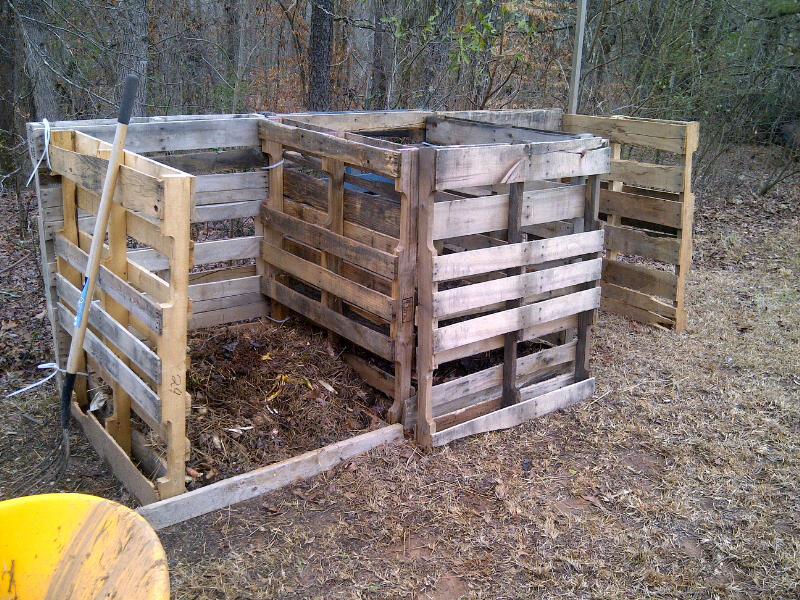
At any composting site there are three basic stages of compost: compost that is ready for use, a completed compost heap that is being cooked, and a new compost heap still being built.  This means that at every site there are three phases present.  While there are many ways to achieve this, nothing more elaborate than wooden pallets were used to frame and partition the heaps due to their low cost, ease of use, and versatility.  Large plastic ties were used to attach the pallets together.  This is simple but effective and the ties can be undone and re-used.  

The picture below shows a three-stage set up used at the original site in the top field.  The relative short distance of the compost heap from the kitchen door can also be seen – closer the better but not too close!


Composting is a key process for improving the soil and fertilizing the plants.  Experience to date suggests applying some thought to the design and location of the compost heaps can make the process more effective and more efficient.

Wednesday, February 15, 2012

New Additions

Recent new additions to the farm include four American Guinea Hogs purchased from Sleaux Greaux Farm in Bush, LA.  The “herd” comprised of a breeding pair and two siblings from the last litter (a gilt and a boar).  The sow is with pig and expected to farrow at the end of May.  American Guinea Hogs are a critically rare breed of pig that is unique to North America. The original stock for the breed developed through adaptation and crossbreeding with Appalachian English pigs to create an American original. They were commonly found on homesteads in the southeastern US.

I drove down to Louisiana on Superbowl Sunday to pick up the hogs.  For transportation I built a wooden cage out of studs and 4x2 welded wire to fit on the back of the Tacoma with the tailgate acting as the door.  The drive time was expected to be around 9 to 10 hours so I considered taking the youngest son to help me stay awake (the fear of him driving my truck would keep me alert enough to drive).  That didn't work out so I took Twix (one of the dogs) for company.  She slept all the way down, woke up just in time to bark at Ed (the man selling the AHGs), and then slept all the way back.  So much for the company!  All four hogs fit in the cage on the back of my truck.  


Despite a few strange looks while stopping for gas, the trip went smoothly.  By the time I arrived back at Hereward the hogs were sound asleep and did not want to leave their cage.  They were enticed down a makeshift ramp and led into a stable for the night.

The Four Guinea Hogs 
The babies are buried in the hay and apologies to all the drivers on I59 on Sunday, February 5th who may have had hay coated in porcine feces blown onto their windshields.


The “babies” are being kept in a wired off section of the garden where they have been rooting things up nicely.  The cover crop and remnants of last season’s garden still need tilling into the soil and these little helpers are doing their thing.  So far the chickens in the top field have been keeping their distance. When finished with the main garden they will be placed in a mobile grazing area built out of four hog panels and moved around every few days.   


The parents are being kept in the free paddock which I reinforced with field fence.  This will only be for a couple of weeks or so.  I am fencing in some of the wilder and wooded sections of the property to give the AGHs a large permanent area to roam and forage.  They will also continue to be used strategically  for tilling.  Their paddock does not have any shelter so a temporary and makeshift shelter was constructed (very makeshift).  I got the design idea from a picture of Haiti after the recent earthquake.  This shelter may be a rare example of one that actually violates the Appalachian Building Code and Standards

Temporary Hog Shelter
Note the strategic use of a hotel towel that must have accidentally ended up in my luggage [along with the matching robe and slippers]).


The Boar Asleep Outside of the Shelter - Clearly he has some standards!


Compared to the commercial breed pigs, the AGHs are exceptionally well-behaved and a real joy to spend time with.  These are very docile and slow growing pigs.  The siblings are nearly 6 months old yet are only the size the commercial breed piglets were when they were shoats (just weaned).  Adults are typically only 150-250 lbs.  The small size and docile disposition make the AGH an ideal homestead pig.  They can also forage for their own food, eating such things as snakes, nuts, rodents, grass and roots.  I hope they eat a lot of snakes!

Hereward Farm is now a member of the American Guinea Hog Association (www.guineahogs.org).


Wednesday, February 1, 2012

Get your foot out of the trough!


I am still amazed at how many expressions found in conversational English are derived from the farmyard.  Examples include pecking order, rule the roost, hen-pecked, greedy as a pig, etc.   One expression I heard growing up was “Get your foot out of the trough!”  Typically this was used to call out some vulgar eating habits.   

So speaking of troughs and pigs, I felt it was time to build the pigs a new trough.  Initially the pigs had two shallow wooden troughs the size of a typical drawer.  These worked for a while but now they are nosed all around the run and it became a frustrating matter of hunting the trough at feeding time.  Walking through the pig run carrying food can be a dangerous experience – the pigs like to nibble on extremities such as boots, jacket, pants, etc.  At best, the pigs’ snouts splatter you in mud so you end up looking like you were a front row spectator at a mud wrasslin’ event.  At worst, the pigs might connect with a sensitive appendage.  I haven’t done the research but I am confident that pig farmers prefer briefs over boxers.

Minimizing injury and to speed up the feeding process the pigs were graduated to a large galvanized steel tub.  This did not work too well.  The pigs hard time reaching the bottom.  When a pig would step into it the whole thing would go arse-over-tit smacking the pig in the face sending the food all over the place making it look like a pig sty.  It was clearly time to build a real trough.

Staying with a traditional “V” shape design, a simple 12 foot x 12 inch x 2 inch plank of untreated wood was purchased at Lowes which they very nicely cut it into two 4 foot pieces and two 2 foot pieces.  At the checkout I got a hard stare when presenting 1 bar code for 4 pieces of wood.  This has given me some ideas.  All that was left to do was screw the two 4 foot pieces together in a “V” using 3 inch galvanized wood screws and then adding on the 2 ends so that the “V” was held a couple of inches off the ground.  The whole thing cost around $12 and took about 5 minutes to assemble (assuming you had the foresight to charge up the drill).

The trough was the perfect size so that four pigs could line up next to each other in an orderly fashion and chomp away.  Yeah, right!  The photos below show what actually happened - some interesting defensive eating tactics.

The first pic shows a foot in the trough maneuver by Hambone (left) is countered by two front feet and a left cheek by Thing 1 (right).


The next pic shows the progression of Thing 1's technique resulting in complete trough domination.


The trough worked well with the only annoyance being the pigs occasionally push it over (it is much heavier than one would think and has a low center of gravity).  One improvement on the next one will be to add another wall so instead of a “V” it will look like a “W” without the last “/”.  This will mean that if the pigs nose it upside down it will be useable from the other side too.  Until then it means donning a pair of Kevlar briefs and weaving through hungry pigs to right the trough.

Saturday, January 14, 2012

Hi ho, hi ho, it’s off to work we go…


The last few weeks have been particularly busy at Hereward.  A key realization this winter was appreciating the fact that when your life is governed by the sunrise and sunset, the shorter winter days mean the work has to be crammed into a shorter period of daylight.  Of course, all work is not of equal value.  An informal analysis of the work activity on the farm so far identified three distinct types of activities:  maintenance activities, progressive activities, and distractions. 

Maintenance activities, as the name suggests, involve work that is required to maintain the status quo.  This involves tasks such as feeding the livestock, maintaining equipment, mending fences, turning compost, weeding the garden, pruning trees, etc.  Progressive activities are those that improve the overall farm operation.  Examples include building a new fence, building a new compost system, working on an irrigation system from the creek, etc.  As the name suggests, distractions are a more dubious activity.  These activities start out with the best intentions but usually end up wasting time and energy or even creating more maintenance work.  The typical day involves many maintenance activities.   If these are not done it will result in distractions later.  However, if the day’s activities involve only maintenance work then little or nothing has been done to improve the farm.  Of course, any distractions should be minimized but distractions start out disguised as poorly planned or misaligned progressive activities. 

Looking back on the last few weeks, much of the work either falls into the distraction category or maintenance work resulting from a distraction.  A good example is the 16 Barred Rock day old chicks hatched on the 26th of November.  The idea was sound – introduce another breed of dual purpose heritage chickens that would free-range in the orchard.  Recognizing that winter is not the ideal time to be raising chicks, the full implications of this decision were not realized until it was too late.  From the end of November until a few days ago, 16 chicks have been living in my office.  Starting out in a small brooder under a 250 Watt heat lamp, the chicks progressed through a series of larger containers to the chick coop and eventually needed a mini-run built out of parts from a child-proof gate.  All this was in my office.  During this time the noise and odor were manageable but the one inch layer of caustic dust they produced became intolerable.

Out of desperation, two days were spent repairing the old chicken tractor that came with the farm and converting it into a run for the chicks that could withstand predators and the cold.  So the chicks at around 7 weeks old finally went out this week and they loved it.  I was finally able to reclaim my office after several hours of disinfecting and dust removal.  Alas, it was a mistake to think the worst was over.  The sub-freezing temperatures several nights this week meant trekking out to the tractor to collect the chicks and put them into a large storage container so they could spend the night in the laundry room (they are now banned from my office).  In the morning they have to be let out again.


All in all, what would normally be a simple task of raising chicks involved many hours of extra work and much inconvenience.  Most of this would have been avoided if we had waited until warmer weather.  The good news about our Buff Orpingtons and Barred Rocks is that they will often go broody and raise their own chicks...  Now why didn't I think of that?

Barred Rock chicks early on:


The ultimate "must have" for every office - an indoor chicken run


Finally outside (note the wire under the run for added predator protection).  The chicks are locked in a coop within this run at night:


The chicks looking a little put out back in their outdoor run after spending a night in the laundry room: