Saturday, January 14, 2012

Hi ho, hi ho, it’s off to work we go…


The last few weeks have been particularly busy at Hereward.  A key realization this winter was appreciating the fact that when your life is governed by the sunrise and sunset, the shorter winter days mean the work has to be crammed into a shorter period of daylight.  Of course, all work is not of equal value.  An informal analysis of the work activity on the farm so far identified three distinct types of activities:  maintenance activities, progressive activities, and distractions. 

Maintenance activities, as the name suggests, involve work that is required to maintain the status quo.  This involves tasks such as feeding the livestock, maintaining equipment, mending fences, turning compost, weeding the garden, pruning trees, etc.  Progressive activities are those that improve the overall farm operation.  Examples include building a new fence, building a new compost system, working on an irrigation system from the creek, etc.  As the name suggests, distractions are a more dubious activity.  These activities start out with the best intentions but usually end up wasting time and energy or even creating more maintenance work.  The typical day involves many maintenance activities.   If these are not done it will result in distractions later.  However, if the day’s activities involve only maintenance work then little or nothing has been done to improve the farm.  Of course, any distractions should be minimized but distractions start out disguised as poorly planned or misaligned progressive activities. 

Looking back on the last few weeks, much of the work either falls into the distraction category or maintenance work resulting from a distraction.  A good example is the 16 Barred Rock day old chicks hatched on the 26th of November.  The idea was sound – introduce another breed of dual purpose heritage chickens that would free-range in the orchard.  Recognizing that winter is not the ideal time to be raising chicks, the full implications of this decision were not realized until it was too late.  From the end of November until a few days ago, 16 chicks have been living in my office.  Starting out in a small brooder under a 250 Watt heat lamp, the chicks progressed through a series of larger containers to the chick coop and eventually needed a mini-run built out of parts from a child-proof gate.  All this was in my office.  During this time the noise and odor were manageable but the one inch layer of caustic dust they produced became intolerable.

Out of desperation, two days were spent repairing the old chicken tractor that came with the farm and converting it into a run for the chicks that could withstand predators and the cold.  So the chicks at around 7 weeks old finally went out this week and they loved it.  I was finally able to reclaim my office after several hours of disinfecting and dust removal.  Alas, it was a mistake to think the worst was over.  The sub-freezing temperatures several nights this week meant trekking out to the tractor to collect the chicks and put them into a large storage container so they could spend the night in the laundry room (they are now banned from my office).  In the morning they have to be let out again.


All in all, what would normally be a simple task of raising chicks involved many hours of extra work and much inconvenience.  Most of this would have been avoided if we had waited until warmer weather.  The good news about our Buff Orpingtons and Barred Rocks is that they will often go broody and raise their own chicks...  Now why didn't I think of that?

Barred Rock chicks early on:


The ultimate "must have" for every office - an indoor chicken run


Finally outside (note the wire under the run for added predator protection).  The chicks are locked in a coop within this run at night:


The chicks looking a little put out back in their outdoor run after spending a night in the laundry room:


Sunday, December 11, 2011

An Interesting Weekend...

During a business meeting in Cyprus many years ago, I noticed a large number of houses on the Island had rebar sticking out of the roof.  I could think of no rational reason that could explain this and out of curiosity asked one of the locals.  What I was told made perfect sense.  Apparently, once you have finished building your house the property tax increases significantly.  So, leaving rebar sticking out the top of the house means technically that the house is still under construction and therefore you pay less tax.   

In much the same, when I was a sales rep driving around the rural southeast I was struck by how many people constructed out-buildings out of old tin and blue tarp.  Why anyone would deliberately make their property resemble a shanty-town was beyond me.  Maybe there was some similar hidden advantage known to the practitioners much like the folks in Cyprus with rebar sticking out of the top of their house.  This weekend I was initiated into the tin and tarp crowd (although I had the decency to choose more earthy colors).


No, this picture is not from an Occupy Wall Street squat but of the meat rabbit operation constructed (using the term loosely) this weekend on the lean-to at the end of the workshop.  Before discussing the merits of the construction technique (or lack of technique), it may be worth discussing why raise rabbits for meat in the first place.  Rabbits provide a high quality meat that is low in cholesterol, require little space, are easy to breed (in fact, they breed like rabbits), easy to process (no plucking), easy to feed, make little or no noise (unlike roosters, cows, etc.), no special equipment needed, and their manure can be used directly on the garden without composting.   A slam dunk in my opinion.  

Rather than use the barn, we decided to start out near the house and use the lean-to at the end of the workshop.  Given the four-hole wire cages offer no protection from the elements the lean-to needed covering.  Thinking this may be a temporary affair, it offered the perfect opportunity to practice with tin and tarp rather than something more permanent.  It was relatively easy to cover the cages with some tin (and the required concrete block) and then cover the lean-to with tarp and 4 mil plastic sheeting.  The rabbits seem to be fine.  An operation as small as this (3 New Zealand does and 1 Californian buck) could feed a family of four and can be run in even a small backyard where livestock may not be allowed.
 
The Californian Buck


One of the New Zealand Does

The next picture shows the utility of tarp and something else I thought I would never do.  I built a chute under the cages to automatically collect the rabbit droppings into a container.  Yes, I am really excited by how much droppings these rabbits produce and how this “poop chute” actually works.  One best practice I learned from this experience – build the chute before you put the rabbits in the cages and that way you won’t be working beneath creatures that appear to be able to crap their own body weight daily.


The Poop Chute - Unlike blue tarp, note how the more aesthetically pleasing silver tarp matches the galvanized metal wall and the j-feeder.


Onto the pigs… We finally herded the pigs from their temporary pen on the top field all the way down to the barn.   This was a very unpleasant experience for all concerned.  First of all, getting a rope on a pig was more difficult than expected.  The pigs protested by resisting and squealing all the way down.  One of the pigs escaped by standing on the loose end of the rope (my bad) and it was a devil to recapture.  They made it relatively no worse for wear and it did not take them long to settle in to their new accommodation.  This is much bigger and offers more protection from the elements.  Just have to run some hot wires around the paddock and they have all this area to roam in.  The paddock also has a livestock loading shoot to make loading the pigs on their final journey a smoother process.

The learning from this experience besides tying a better knot - better planning, particularly with large livestock.  If we had planned more effectively we could have placed the pigs in the barn in the first place.

One of the pigs resisting... You'd think she was being led to the butcher's or something. 


The Destination

 Finally made it!  Rabbits are definitely easier to move!


Monday, November 28, 2011

Over Thanksgiving

Several updates over the very busy Thanksgiving holiday period. 

Pigs
The piglets are literally growing before our eyes.  The initial plan was to wire off a garden section with electric fencing and raise the pigs in this area.  Realizing we may need this area before their manure has rotted sufficiently we are now pig-proofing part of the barn and paddock.  While still in their original temporary pen we decided on an impulse to let them out and explore one of the garden areas.  It is amazing how they can be running for their life squealing and then one nanosecond later can be happily rooting and eating - until spooked again.  This temporary freedom seemed like a good idea until we tried to get them back into their pen.  I always wondered where the expression "like trying to catch a greased pig" originated from.  Now I know why.  After numerous failed wrangling attempts human ingenuity prevailed - a line of corn chips caused them to eat their way back into their pen.


Eggs and Chickens (or is it Chickens and Eggs?)
Quite a few developments with the other half of the egg and bacon equation.  We have expanded our Buff Orpington flock over the last few weeks with groups of birds from several local farms that in turn originated from different hatcheries.  Our thinking is to have sufficient genetic diversity in our core flock.  When introducing new hens there is always the risk of contaminating the existing flock with a disease so the new birds are kept isolated for 2 weeks.


Alfred and Edward are now mature enough to be sexually active.  In fact, they have been going at it with the hens like the proverbial hammer and tongues.  We therefore took a chance and incubated 15 eggs that were set on Thanksgiving.  This batch also includes a couple of ISA hen /BO rooster (Harold) eggs from the other coop.  Not sure what type of throwback will result from that liaison but the offspring should be interesting.


We also brought home 16 Barred Rock day-old chicks from a local farm.  This is another large dual purpose heritage breed we want to try out.  This is not the easiest time of year to be dealing with chicks given the winter temperatures so we are making use of the house.  Right now it is becoming difficult to remember which rooms not to let the dogs into.  To be fair to the dogs, they do sort of resemble a dirty tennis ball.


Saturday, November 19, 2011

Odds and Sods

Last weekend was the first time more than one of the feral cats were seen at the same time for a few weeks.  There is usually one cat in the barn at feeding time.  Since all three looked the same when they arrived you never know if you are seeing the same one every time.  One of them is a little less feral and comes up to the house all the time (if the dogs are not out).   The picture shows two cats well camouflaged.  Now we know there at least two cats still here.  Since the one dead mouse found in the barn soon after they arrived the only kill that can definitely be chalked up to the cats was a squirrel found near the barn.


Pumpkins and other gourds were found growing behind the old chicken coop when we moved in.   Judging by the ground this area may have been a chicken run at one time.  Since chickens are often given pumpkin seeds to eat in order to get rid of intestinal worms, we don’t know if these pumpkins were planted here deliberately or are seeds that the chickens did not eat.  This area is very woody so the pumpkins were still green last weekend even though it was well after Halloween.  Here are a few we picked and left in the top field to ripen in the Sun.  By this weekend the larger ones had changed to the familiar orange color.  


Having the mobile chicken coop in the top field and the permanent one in the orchard always meant a long walk in the morning.  With the introduction of the pigs last weekend it has added another step to the morning feeding run.  Applying a process analysis approach to the whole thing we realized that the feeds were in the shed and the animals were spread out in different directions with the shed being out of the way.  The optimal location for the feed was at the house.  So, last week we moved the feed bins onto the front porch.  From a process improvement perspective this move worked really well.  The bad news, the front porch looks more like a barn.  First thing on a cold winter morning dragging feed all around the place tends to favor sacrificing some aesthetics in favor of practicality!


Monday, November 14, 2011

The Piggery

Yesterday we went to collect two Yorkshire/Duroc piglets from Shelby.  While small, these little suckers already weight 25 lbs.  They should reach a market weight of around 300 lbs when they are 120 days old.  Rather than confining them to a small pig pen, the plan is to allow them to free-range among the fields to "poop and root" using a roaming solar-powered electric fence to keep them in desired areas.  The pigs' temporary home is a chain linked dog run.  Last night we were debating whether or not raccoons would climb the fence and pose a problem to the piglets.  More for our peace of mind than the safety of the pigs we moved them onto the front porch last night - much to the disgust of the dogs.

Recognizing that these pigs are being raised for a specific purpose, we spent some time debating their names.  We ended up with the rather bland Thing 1 and Thing 2 after Dr. Seuss' Cat in the Hat mayhem characters.  I had some specific names in mind that were closer to home but all the self-awareness and self-management training over the years has clearly paid off and I remained silent.

Having had no experience in raising pigs the plan is to first try out some common commercial breeds before investing in the rarer heritage breeds.

Thing 1 and Thing 2 in their temporary home:

Wednesday, November 9, 2011

Undesirable Creatures

Recently ran into some less-desirable creatures.  While moving the chickens' water dispenser there was a black widow spider in the gap between the stones that the dispenser was resting upon.  The red hourglass can be clearly seen.  I am not sure what bothers me the most about these spiders.  The fact that it is the most venomous spider in the US or the fact that the female eats the male after mating (hence the name black widow).  I feel better thinking this one was a virgin.


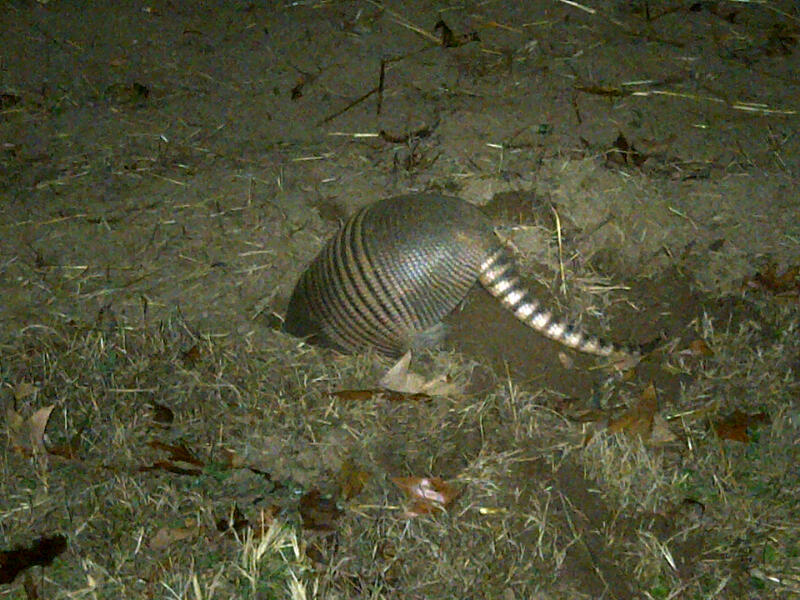
Just before bedtime last night I was out checking on the chickens and found the culprit that had been digging the small deep holes in the fields.  Clearly this thing had not escaped from a petting zoo nor was someone's lost pet.


The armadillo is one of those creatures that one has a really hard time trying to see the beauty in.  In fact, it is down right ugly.  It doesn't help that armadillos carry the bacterium that causes leprosy.  About 1/3 of the few hundred cases of leprosy a year in the US have been found to come from contact with armadillos.  Oh, and they may also carry rabies - nice!

There is plenty of land for it to forage on so no plans to have it/them removed unless they start coming near the house. 

Sunday, November 6, 2011

Planting Garlic

The first of the heirloom garlic was planted this weekend.  The chickens had been depositing rich organic waste material onto the soil of their run for a while.  This was the ground where the garlic would be planted.

The first order of business was moving the chicken coop and run.  The fence and coop were dismantled and moved to the adjacent section of the field to begin preparing some new ground for us. This was relatively simple although I wouldn't want to do this every week.  The only real difficult part was keeping the chickens contained while their world was disrupted. 

Moving the coop:


The old location left some prime well-prepared soil to plant the garlic in:


The soil had first to be tilled and prepared into rows:

That was it for the day.  Had to get ready for the Alabama vs LSU game.  As it turned out there was more crap played during the game than left by the chickens.  Anyway, back to the garlic.  The heirloom garlic bulbs from earlier in the year were broken up into cloves.  The large cloves were selected for planting.  Typically a large clove produces a large bulb and vice versa.  Lot's of garlic left over! The cloves were planted 2 inches deep 6 inches apart.  The cloves go in with the root end facing down (apologies for pointing out the obvious).  A stick marked up for 2 inches and 6 inches works well.

The garlic will winter in the ground and be ready next Spring.  The only step left is cover with about 6 inches of mulch.  We decided on fallen leaves since there are plenty available.

With the recent passing of the tough Alabama Immigration law, casual farm laborers from our neighbors to the South are in short supply.  Being forced to look closer to home the following is a picture of an undocumented Anglo-Appalachian American (son) raking leaves last weekend.  This pile cost me $30!

These leaves came in really handy today:


Nearly 200 cloves went in on this planting. Look forward to some giant heirloom garlic bulbs in the Spring!